


Intensive Workshop on Chakra Meditation
(Based on teachings of Shiva Samhita)
by Dr. Santosh Pandey
15th to 20th December 2025
(Check-in: 14th December
Check-out: 21st December)
शिवसंहिता – पञ्चम अध्याय – श्लोक 62
Sanskrit (Devanāgarī)शिरः कपालें रुद्राक्षं विवरं चिन्त्येद् यदा।
तदा ज्योतिः प्रकाशः स्याद् विद्युत् पुञ्जसमप्रभः॥— शिवसंहिता, पञ्चमः अध्यायः (Chapter 5)
Transliteration
śiraḥ kapāle rudrākṣaṃ vivaraṃ cintyed yadā,
tadā jyotiḥ prakāśaḥ syād vidyut puñja-samaprabhaḥ.
Meaning (English)
When the aspirant contemplates upon the Rudrākṣa like Space in kapala or at the crown of the head (śiraḥ kapāla),then a divine light arises — shining with brilliance like a cluster of lightning.
Interpretative Meaning
This verse describes an advanced stage of meditation where concentration on the Kapalrandhra with the electric illuminated light’s visualization awakens an inner radiance — the effulgence of divine consciousness, symbolized as a lightning-like illumination in the subtle body.
Awaken the Inner Energy. Discover the Light Within.
A transformative workshop on Chakra Meditation, inspired by the sacred wisdom of the Shiva Samhita — one of the most profound yogic treatises ever written. This program invites participants to explore the subtle architecture of the human body as described by the ancient sages — a universe of energy channels (nāḍīs), centers of consciousness (chakras), and the divine power of awakening (Kuṇḍalinī).

Introduction to the Shiva Samhita and the Chakra System
The Shiva Samhita, a revered Sanskrit scripture on Hatha Yoga, unveils the inner science of human evolution — physical, mental, and spiritual. Presented as a dialogue between Lord Shiva and Goddess Parvati, the text is a luminous guide to unlocking hidden potentials through disciplined practice, meditation, and awareness of subtle energy flow.
According to the Shiva Samhita, the human body is a sacred temple composed of seven primary chakras, aligned along the spinal axis — from the Mūlādhāra (Root Chakra) at the base to the Sahasrāra (Crown Chakra) at the top.
Each chakra vibrates with a distinct frequency, element, color, and mantra — influencing specific organs, emotions, and states of consciousness.
The journey of meditation through these seven centers represents a gradual ascent from instinct to intuition, from matter to spirit, and from self-awareness to cosmic consciousness.
Workshop Overview
This immersive workshop blends the philosophical essence of the Shiva Samhita with guided experiential practices. Participants will explore:
Chakra Awareness & Energy Mapping
Understanding the role, location, and symbolism of each chakra.
Mantra & Sound Meditation
Chanting bīja mantras and upabīja mantras to activate vibrational resonance.
Chakra Sādhana
Gentle and safe methods to heal and elevate inner energy.
Breath & Prāṇa Flow
Techniques to balance the flow of energy through the nāḍīs.
Visualization & Color Meditation
Engaging gold and blood-red hues alternately from Mūlādhāra to Sahasrāra as per Shiva Samhita Chapter 5.
The Path of Transformation
Through consistent practice, Chakra Meditation refines the mind, purifies the emotions, and harmonizes the body’s energy system. The Shiva Samhita reveals that when prāṇa flows unobstructed through the chakras, one experiences:
- Mental clarity and inner calm
- Enhanced vitality and focus
- Emotional balance and creative expression
- Spiritual illumination and self-realization
The Essence
The Shiva Samhita teaches that “the human body is a universe in itself”.
By diving inward, the seeker encounters the sacred fire of Kuṇḍalinī, the eternal spark of divine consciousness residing at the base of the spine.
When this energy rises — guided by devotion, discipline, and awareness — it merges into the thousand-petalled lotus of the Sahasrāra, symbolizing union with the Supreme Consciousness.
Join us for this sacred journey inward —
to listen, feel, and awaken the divine vibration that resides within you.
Through the teachings of the Shiva Samhita, discover how meditation becomes not just a practice —
but a revelation of your highest potential.
Workshop Structure and Activities
This Chakra Meditation Workshop, inspired by the sacred teachings of the Shiva Samhita, unfolds as a holistic journey combining theory, practice, sound, and silence. Each activity is designed to harmonize the physical body, awaken subtle energy centers, and lead the participant toward deep inner stillness.
The workshop begins with an insightful exposition on the seven primary chakras as described in the Shiva Samhita.
Participants will explore:
- The location, symbolism, and energetic attributes of each chakra.
- The mantras, colors, and psychological qualities associated with every energy center. Through verses and commentaries, the facilitator unveils how each chakra serves as a doorway to higher states of consciousness — mapping the journey from the Mūlādhāra (root of existence) to the Sahasrāra (crown of illumination).
The participants are guided through specific āsanas that stabilize the body and prepare it for meditative stillness.
A series of foundational prāṇāyāmas, derived from the Shiva Samhita’s teachings, are introduced to refine the flow of prāṇa through the nāḍīs.
These breathing practices help anchor awareness, expand lung capacity, and awaken the subtle movement of energy along the spinal axis — the path of Kuṇḍalinī.
Silence is the bridge between sound and self-awareness.
Participants are invited to enter periods of observant silence, allowing the effects of meditation to settle inward.
In this stillness, one learns to listen — not to the world outside, but to the quiet rhythm of breath, the pulse of energy, and the whisper of the soul.
The core of the workshop centers around a guided meditative ascent through the chakras, from root to crown.
Participants visualize:
- The color, form, and qualities of each chakra, as revealed in Shiva Samhita Chapter 5.
- The resonant bīja (seed) mantras — “LAM” (Mūlādhāra), “VAM” (Svādhiṣṭhāna), “RAM” (Maṇipūra), “YAM” (Anāhata), “HAM” (Viśuddha), “OM” (Ājñā), and silent vibration at Sahasrāra.
This meditative progression uses gold and blood-red visualization alternately from base to crown, symbolizing vitality and transcendence.
Each session integrates sacred sound practices to deepen energetic attunement:
- Chanting of seed syllables (bīja mantras) and sub-seed syllables (upabīja mantras) to harmonize the chakras.
- Kharaj Sādhana — development of deep vocal resonance to purify the nāda, the inner sound current.
- Omkar Sādhana at 136.1 Hz frequency — a meditative alignment with the earth’s fundamental vibration, invoking stability and serenity.
Through rhythmic breath and sound, the practitioner’s mind synchronizes with the vibrational essence of each energy center, opening pathways for profound healing and awareness.
In this sacred practice, participants internalize mantras by mentally installing divine vibrations at different points of the body.
This powerful meditative ritual aids in deep physical, emotional, and psychic healing, aligning the microcosmic body with the cosmic field of energy.
It cultivates a sense of wholeness — where body, breath, and consciousness exist in luminous harmony.
After meditation, participants are gently guided into reflective silence and open sharing.
This space allows for the articulation of inner experiences — sensations of light, emotion, vibration, or release — fostering collective insight and empathy.
Through shared dialogue, participants recognize the universality of the inner journey and the sacred connection among seekers.
Expected Outcomes and Benefits
By the conclusion of the workshop, participants can expect to experience a renewed sense of harmony and vitality. The practices collectively aim to bring about:
- Heightened self-awareness and emotional equilibrium.
- Deeper understanding of yogic anatomy and the subtle energy system described in ancient texts.
- Techniques for balancing chakras, leading to improved mental clarity and physical well-being.
- Relief from stress, anxiety, and pranic blockages, restoring the natural flow of life-force.
- A sense of spiritual awakening, as participants learn to perceive the body not merely as physical — but as a living temple of divine consciousness.
1. Physiological Benefits
Regular practice of intensive chakra meditation harmonizes the body’s energy flow, preventing various physical and psychosomatic ailments:
- Muladhara Chakra: Balances the musculoskeletal, circulatory, and reproductive systems; prevents arthritis, spinal, and blood-related disorders.
- Swadhisthana Chakra: Regulates urinary and reproductive health; helps overcome infertility, prostate, and hormonal issues.
- Manipura Chakra: Enhances digestion and vitality; prevents gastric, intestinal, and metabolic disturbances.
- Anahata Chakra: Strengthens the heart and lungs; alleviates anxiety, depression, and respiratory imbalances.
- Vishuddhi Chakra: Supports thyroid and throat health; clears upper respiratory and lymphatic blockages.
- Ajna Chakra: Regulates endocrine function; reduces stress, eye strain, and emotional imbalance.
- Sahasrara Chakra: Harmonizes hormonal and neurological systems; fosters mental clarity and inner peace.
Through consistent sādhanā, one attains physical vitality, emotional stability, and spiritual balance.

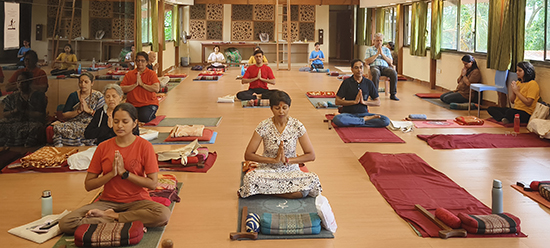
2. Spiritual & Energetic Benefits
- Restores and stabilizes pranic flow in all chakras.
- Purifies the nāḍīs and subtle energy cords, preventing energetic depletion.
- Releases suppressed emotions, promoting deep emotional healing.
- Facilitates profound meditation and inner stillness.
- Reduces stress through the synergy of Chakra, NAdis and Nāda (Music) Therapy, leading to higher states of awareness and peace.
This workshop is more than an introduction to meditation —
it is an initiation into inner alchemy, guiding each participant from the gross to the subtle,
from the seen to the unseen, and from sound to silence.
Daily Schedule
(Timings can be adjusted as per group flow and environment)
The first day is devoted to grounding, understanding, and preparation — creating a sacred space for deep inner exploration. Participants are gently introduced to the principles of Shiva Samhita, the philosophy of chakras, and foundational practices of breath, sound, and stillness.
Session 1: Introduction, Foundation & Theoretical Immersion
Time: Morning 9:00 a.m. to 12:00 p.m.
Focus: Setting the intention and building the inner ground for meditation.
Highlights:
- Welcome & Orientation: Introduction to the spirit of the workshop — creating a sacred container of trust, silence, and awareness.
- Commitment to Silence: Understanding Mauna (the discipline of silence) as a pathway to heightened perception.
- Journaling & Reflection:
- Sharing the value of self-observation and intuitive journaling.
- Guidance on recording sensations, thoughts, colors, or emotions after each meditation.
- Comfort & Readiness:
- Checking participant preferences — chair or floor seating for extended meditation.
- Ensuring physical ease and emotional readiness for inward work.
- Group Connection: Gentle introductions, intention sharing, and opening circle to establish collective harmony.
- Theory & Foundation:
- Overview of the Shiva Samhita and its teachings on subtle anatomy — nāḍīs, chakras, and Kuṇḍalinī.
- Understanding the seven primary chakras, their locations, colors, mantras, and symbolic meanings.
- The upward journey from Mūlādhāra (root) to Sahasrāra (crown) as the evolutionary path of consciousness.
Outcome: Participants gain conceptual clarity, establish a reflective mindset, and prepare mentally for experiential sādhanā.
Session 2: Prāṇāyāma, Omkār Sādhana & Guided Chakra Meditation with Nyāsa
Time: Evening 2:30 p.m. – 6:30 p.m.
Focus: Deepening awareness through breath, vibration, and inner visualization.
Highlights:
- Prāṇāyāma Practices:
- Introduction to gentle cleansing and balancing prāṇāyāmas — Nadi Shuddhi, Anuloma Viloma, and Bhrāmari.
- Understanding how prāṇa flows through Ida, Pingala, and Sushumnā nāḍī.
- Omkār Sādhana:
- Chanting and meditating on Om at the 136.1 Hz frequency — the Earth’s natural resonance (Shiva Samhita reference to cosmic vibration).
- Developing kharaj (deep vocal resonance) to purify the nāda or inner sound current.
- Guided Chakra Meditation with Nyāsa:
- Sequential activation of the seven chakras using bīja mantras (LAM, VAM, RAM, YAM, HAM, OM).
- Visualization of alternating gold and blood-red colors, symbolizing transformation and spiritual ascent.
- Incorporation of Nyāsa Sādhana — placing mantra vibrations mentally on various parts of the body for inner healing and alignment.
- Closing Silence & Reflection:
- Observing inner sensations post-meditation.
- Journaling subtle experiences — warmth, vibration, stillness, or emotion.
Outcome: Participants experience a harmonized flow of breath and energy, awaken subtle awareness of chakras, and learn foundational tools for personal daily practice.
Time: 5:30 a.m. to 6:30 a.m. – Yoga Asanas and Inner Reflection
(Morning 9:00 a.m. to 12:00 p.m. | Evening 2:30 p.m. to 6:30 p.m.)
Morning Session:
- Kharaj Sādhana: Cultivating deep vocal resonance; awakening the inner Nāda.
- Omkar Sādhana: Extended chanting in all three pitches (low, mid, high) for prāṇic balance.
- Prāṇāyāma Series I: Nadi Shuddhi and Bhrāmari to cleanse Idā, Piṅgalā, and Suṣumnā.
Evening Session (at Swamiji’s Kuti):
- Full Chakra Meditation: Color and mantra visualization from Mūlādhāra to Sahasrāra.
- Full Nyāsa Meditation: Placing mantra vibrations through body awareness.
- Shiva Sādhana I: Invocation of inner stillness through chanting “Om Namah Śivāya.”
Theme: Grounding in vibration, aligning body-mind with the living presence of Shiva Consciousness.
Time: 5:30 a.m. to 6:30 a.m. – Yoga Asanas and Inner Reflection
(Morning 9:00 a.m. to 12:00 p.m. | Evening 2:30 p.m. to 6:30 p.m.)
Morning Session:
- Kharaj Sādhana: Voice-flow with breath retention.
- Omkar Resonance Practice: Chanting with awareness of the heart’s vibration.
- Prāṇāyāma Series II: Ujjāyī and Bhastrikā (pre-Chakra cleansing preparation).
Evening Session (at Swamiji’s Samādhi):
- Full Chakra Meditation II: Deepening visualization with alternate colors (gold & blood red).
- Deep Nyāsa Dhyāna I: Focused on physical and emotional healing.
- Pañchadaśī Mantra Meditation: Integration of Śakti-Mantra for inner illumination.
Theme: Awakening devotion and subtle perception in the sacred stillness of Samādhi.
Time: 5:30 a.m. to 6:30 a.m. – Yoga Asanas and Inner Reflection
(Morning 9:00 a.m. to 12:00 p.m. | Evening 2:30 p.m. to 6:30 p.m.)
Morning Session:
- Kharaj Sādhana: Sound purification through long-scale chanting.
- Omkar at 136.1 Hz: Merging sound with cosmic rhythm.
- Prāṇāyāma Series III: Nadi Shuddhi for 50 rounds for vitality and focus.
Evening Session (at Swamiji’s Cave):
- Shiva Sādhana II: Meditation on the silent aspect of Śiva (formless consciousness).
- Full Chakra Meditation III: Emphasis on Ājñā and Sahasrāra.
- Deep Nyāsa Dhyāna II: Energy healing through awareness of divine light in each chakra.
Theme: Dissolving ego layers in the still cave of the heart — where sound returns to silence.
Time: 5:30 a.m. to 6:30 a.m. – Yoga Asanas and Inner Reflection
(Morning 9:00 a.m. to 12:00 p.m. | Evening 2:30 p.m. to 6:30 p.m.)
Morning Session:
- Daily Kharaj & Omkar Sādhana: Refining tone, depth, and continuity.
- Prāṇāyāma Series IV: Nadi Shuddhi and Bhastrikā for healing and emotional balance.
Evening Session (at the Mountains):
- Chakra Healing Meditation: Visualizing the mountain as the spine of Mother Earth.
- Pañchadaśī Mantra Japa: Harmonizing Śiva–Śakti energies within.
- Deep Nyāsa Dhyāna III: Integration of color, mantra, and breath for pranic healing.
Theme: Re-establishing equilibrium between inner energy and nature’s vast stillness.
Time: 5:30 a.m. to 6:30 a.m. – Yoga Asanas and Inner Reflection
(Morning 9:00 a.m. to 12:00 p.m.)
Morning Session:
- Final Kharaj & Omkar Sādhana: Group resonance for collective energy elevation.
- Full Chakra Meditation IV: Culmination and ascent through all seven chakras.
- Shiva Sādhana III: Union of Śiva and Śakti within.
- Closing Circle & Reflections: Sharing experiences, insights, and gratitude journaling.
Theme: Integration, transformation, and surrender — the seeker becomes the silence itself.
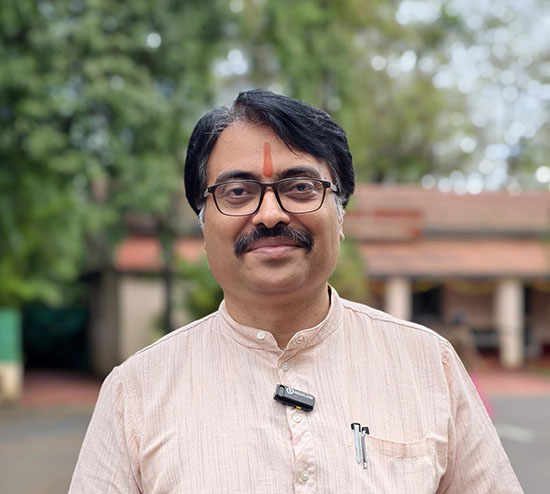
Workshop Facilitator
Dr. Santosh Pandey
Consultant Naturopath in Kaivalyadhama Health Care Center, Lecturer in Kaivalyadhama College. Senior Yoga and Naturopathy Physician
Dr. Santosh Pandey is a distinguished expert in Naturopathy, Yoga Therapy, and Acupressure & Acupuncture, with over 24 years of experience. He holds a B.N.Y.S., Master Diploma in Yoga Therapy, MBA in Hospital Administration, and is a Reiki Grand Master Level 12 and Advanced Pranic Healer. He has received the President’s National Award and a Gold Medal in Yoga and Naturopathy (2005). Dr. Pandey’s expertise spans Yoga Therapy, Naturopathy, Wellness & Spa Treatments, and both Basic & Advanced Acupressure Healing. He has held roles in administration, research, consultation, and development across various institutes and participated in numerous conferences. With a focus on Basic Medical Sciences, Yoga Philosophy, and Chakra Meditation-practiced for 35 years and taught for 20-Dr. Pandey is a prominent figure in wellness and alternative medicine, blending traditional and modern techniques to promote holistic health.
Registration
Note: The fresh dates will be announced soon.
Please visit the link here for Room Details
(The complete package pricing for the workshop along with accommodation is as given under “Workshop fees including accommodation and meals”)
Workshop fees including
accommodation and meals
Single Standard Room with common bath is not available
Single Standard Room with attached bath is not available
Single Deluxe Room without AC is not available
Single Deluxe Room with AC is not available
Single Keshav Kutir with AC is not available
Registration Till 23rd November 2025
- Single Standard Room with common bath: Rs. 23,200/-
- Single Standard Room with attached bath: Rs. 28,100/-
- Single Deluxe Room without AC: Rs. 37,200/-
- Single Deluxe Room with AC: Rs. 39,300/-
- Single Anand Room with AC: Rs. 50,500/-
- Single Keshav Kutir with AC: Rs. 40,000/-
Late Registration 24th November 2025, onwards
- Single Standard Room with common bath: Rs. 25,200/-
- Single Standard Room with attached bath: Rs. 30,100/-
- Single Deluxe Room without AC: Rs. 39,200/-
- Single Deluxe Room with AC: Rs. 41,300/-
- Single Anand Room with AC: Rs. 52,500/-
- Single Keshav Kutir with AC: Rs. 42,000/-
Please Note:
- On registration to the workshop, you will be redirected to payment page for partial advance for the workshop.
- On confirmation of pyment your seat to the workshop will be reserved.
- If doing a Late registration as per the dates given above, then we will require the full workshop package amount to be paid for confirmation of th registration.
- On reciept of the advance payment we will promptly begin the process of you room booking and workshop registration. We will get back to you with the availablity of room and balance payment to confirm the seat in the workshop.
Cancellation and Refund Policy
Accommodation and meals
If you find it necessary to cancel your reservation, here’s what you can expect:
- Cancellations made more than 1 month prior to your arrival date are eligible for a full refund, excluding any applicable transaction fees.
- Cancellations made before 7 days of the scheduled arrival date will qualify for a 75% refund of the total amount paid.
- Cancellations made within 7 days of the scheduled arrival date, no refund will be provided.
To initiate your cancellation, please send an email to booking@kdham.com. Kindly be informed that we do not accept cancellation requests over the phone.


