


Meditation: From Stress to Absolute Wellness
by Dr. R. S. Bhogal
17th to 22nd April 2023
(Check-in: 16th April
Check-out: 23rd April)
Yoga Science caters to a comprehensive wellness often referred to, in ancient yogic literature, as Ananda, Prasada or Absolute Joy. Yoga speaks of one’s journey from Phenomenal Wellness to Transcendental Wellness, indicative of a practical balance between social self and Individual Self, thus encompassing our journey from the existential inadequacies towards the entire spectrum of well-being and wellness.
What is Dhyana (Yoga Meditation)?
“Dhyana (Yoga Meditation) is the very process of restoring our psychophysiological faculties towards Total Health, through achieving an ideal interaction of Citta (mind, intellect & ego) and Prana (bio-force responsible for functional domain of our body), culminating into Absolute Joy, through Continual Health, Creativity and Intuition.”
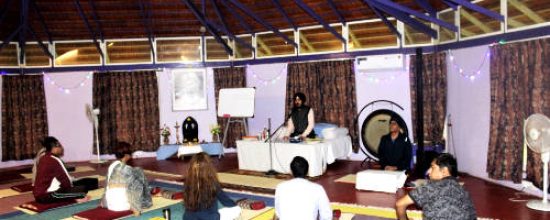
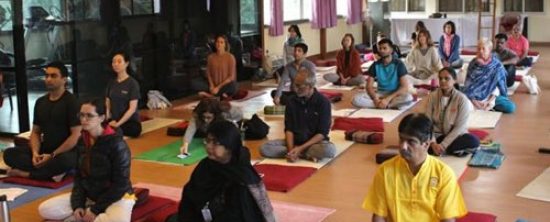
What is Absolute Wellness?
The wellness not conditioned by our environment, as well as, not influenced by fruition of Kleshas (inborn afflictions) is Absolute Wellness. Constant vigilance indicative of Comprehensive Awareness and Constant Creativity indicative of Comprehensive Freedom lead us to Absolute Wellness, whereby the human well-being and wellness is continual without any environmental influences, intra-individual inadequacies and inter-individual problems, whatsoever.
How does Yoga Meditation Help?
As per Patanjala Yoga Sutra (P.Y.S.), Yoga spells the freedom from the slavery of functions of mind-intellect-ego complex, culminating into the state of Seer (PYS: II: 2, 3). This state, where awareness is maximum and tensions are minimal, paves way to Neutral State of Attention, the state, when brought forth consciously, leads to equanimity (Samatvam) which is forerunner to Creativity (B.G. II: 48 & 50). There happen possibilities of emergence of intuitive powers, many of which have been mentioned in Vibhuti Pada of P.Y.S. Neutral State of attention, indicated by Abstract Awareness (Amoorta Bhava) is the bed rock of the states of Samyama, wherein intuitive powers effuse forth. Creativity and Intuitive Powers lead us to Absolute Joy which in turn leads to Creativity and Intuitive powers. Here emerges Absolute Wellness, the perennial state of individual and social well-being when all human possibilities get expressed.
What is Stress?
Stress is defined as, “a maladaptive response pattern, characteristic to the individual concerned, to his overpowering and perceived psycho-physiological and bio-eco-sociological demands.”
What is Stress, as Inferable from Patanjala Yoga Sutra?
A state of psycho-physiological imbalance, experienced due to identification with one’s mental modification, emanating from our inborn existential afflictions, termed as kleshas, when getting precipitated by unfavorable social environment and one’s dissonant psycho-physiological response pattern.”
The Nature of this Workshop

How does Yoga Meditation help?
As per Patanjala Yoga Sutra (P.Y.S.), Yoga spells the freedom from the slavery of functions of mind-intellect-ego complex, culminating into the state of Seer (PYS: II: 2, 3). This state, where awareness is maximum and tensions are minimal, paves way to Neutral State of Attention, the state, when brought forth consciously, leads to equanimity (Samatvam) which is forerunner to Creativity (B.G. II: 48 & 50). There happen possibilities of emergence of intuitive powers, many of which have been mentioned in Vibhuti Pada of P.Y.S. Neutral State of attention, indicated by Abstract Awareness (Amoorta Bhava) is the bed rock of the states of Samyama, wherein intuitive powers effuse forth. Creativity and Intuitive Powers lead us to Absolute Joy which in turn leads to Creativity and Intuitive powers. Here emerges Absolute Wellness, the perennial state of individual and social well-being when all human possibilities get expressed.
Cleansing Samsakars (the enduring impressions embedded at the unconscious levels) i.e. Yogic Detox
Practical form of Shuddhi Kriyas, Pratyahara, Kriya Yoga and Dharana, equipped to carry out the yogic detox, leading to the state of Dhyana will be included during this phase. Many a samskar are embedded in the sensory motor levels for which ancient sages have discovered Pratyahara & Dharana techniques that use exteroceptive, proprioceptive, interoceptive and vestibular impulses.
Achieving Yogic Life Style
Primarily equanimity (samatvam) and creativity (karmasu kaushalam) make our life style a yogic one. Appropriate Dharana methods that lead us to Absolute Joy (Prasada) will be included in this phase. Many a Dharana technique requires us to feel non-muscular impulses within the body, through Mantras, Bija Mantras, Bandhas & Mudras, as well as, through the experiential breathing awareness techniques.
Practical Meditative Processes:
- To counter weakness after a prolonged illness
- To get rid of physical exertion and headaches instantly,
- To help in digestive disorders,
- To help relieve non-clinical anxiety, depression quickly,
- To help pain management effectively,
- To help maintain our psycho-physiological health, in all situations, most efficiently.
Higher states of consciousness will be reached through Samyama practices
Chakra Bhedana and other subtler meditative processes leading us to continual intuitive abilities, useful for solving our existential problems, as well as, helping us to achieve higher states in Dhyana and Samadhi. Subtler subjective impulses, independent of the breathing, as well as, independent of exteroception, interoception and vestibular domains, culminating into a deep sense of inward and ecstatic experience of fulfillment will be experienced by the participants during this final phase of the workshop. Discovering one’s own self-sustaining prowess during the workshop that makes bed-rocks for continual intuition towards solving one’s life related problems in sure-fire ways.
Key Takeaways
- Understanding the concept & practice of Dharana & Dhyana as per Bhagwat Gita, Patanjala Yoga Sutra, Shiva Samhita & Vijnana Bhairava Tantra.
- Understanding modern and Yogic perspectives of Stress. Why the need of yogic approach to wellness? What are limitations in modern view? Complementarity between both these approaches will be dealt with.
- Understanding “Absolute Joy” and the availing tips for experiencing it for Continual Health, Creativity & Intuition.
- Understanding Nine Chakras and practical ways to access the same towards meditation, as per Vijnana Bhairava Tantra.
- Dharana Practices from Vijnana Bhairava Tantra, Basic tenets and down-to-earth stages of the practical journey towards Dhyana, from Buddhist tradition and Upanishads & from living traditions.
- Practical Meditative Techniques for preventing and help overcoming Stress related Disorders, as well as, health related issues such as common ailments, headache and cold. Meditational practices for psychic & psychosomatic disorders such as anxiety, depression, body-ache, insomnia and migraine will also be a part of the program.
- Some quick & sure-fire Dharana & Kriya Yoga Techniques leading to Dhyana for daily use.
- Instant benefits in case of disturbed mind, hurt feelings, depressive mood states, disinterestedness, occurrence of frequent mental tensions etc.
- Helps maintain a calm and composed disposition irrespective of unfavorable happenings around.
The nature of this workshop
Dates: 17th to 22nd April 2023
1. Date: 17th and 18th April 2023
Cleansing Samsakars (the enduring impressions embedded at the unconscious levels) i.e. Yogic Detox:
Practical form of Shuddhi Kriyas, Pratyahara, Kriya Yoga and Dharana, equipped to carry out the yogic detox, leading to the state of Dhyana will be included during this phase. Many a samskar are embedded in the sensory motor levels for which ancient sages have discovered Pratyahara & Dharana techniques that use exteroceptive, proprioceptive, interoceptive and vestibular impulses.
2.Date: 19th and 20th April 2023
Achieving Yogic Life Style:
Primarily equanimity (samatvam) and creativity (karmasu kaushalam) make our life style a yogic one. Appropriate Dharana methods that lead us to Absolute Joy (Prasada) will be included in this phase. Many a Dharana technique requires us to feel non-muscular impulses within the body, through Mantras, Bija Mantras, Bandhas & Mudras, as well as, through the experiential breathing awareness techniques. Practical meditative processes:
i. to counter weakness after a prolonged illness
ii. To get rid of physical exertion and headaches instantly,
iii. To help in digestive disorders,
iv. To help relieve non-clinical anxiety, depression quickly,
v. to help pain management effectively,
vi. To help maintain our psycho-physiological health, in all situations, most efficiently.
3.Date: 21st and 22nd April 2023
Higher states of consciousness will be reached through Samyama practices:
Chakra Bhedana and other subtler meditative processes leading us to continual intuitive abilities, useful for solving our existential problems, as well as, helping us to achieve higher states in Dhyana and Samadhi. Subtler subjective impulses, independent of the breathing, as well as, independent of exteroception, interoception and vestibular domains, culminating into a deep sense of inward and ecstatic experience of fulfillment will be experienced by the participants during this final phase of the workshop. Discovering one’s own self-sustaining prowess during the workshop that makes bed-rocks for continual intuition towards solving one’s life related problems in sure-fire ways.
Date: 17th to 18th July 2023 Topic: Cleansing Samsakars (the enduring impressions embedded at the unconscious levels) i.e. Yogic Detox |
Practical form of Shuddhi Kriyas, Pratyahara, Kriya Yoga and Dharana, equipped to carry out the yogic detox, leading to the state of Dhyana will be included during this phase. Many a samskar are embedded in the sensory motor levels for which ancient sages have discovered Pratyahara & Dharana techniques that use exteroceptive, proprioceptive, interoceptive and vestibular impulses. |
Date: 19th to 20th July 2023 Topic: Achieving Yogic Life Style |
Primarily equanimity (samatvam) and creativity (karmasu kaushalam) make our life style a yogic one. Appropriate Dharana methods that lead us to Absolute Joy (Prasada) will be included in this phase. Many a Dharana technique requires us to feel non-muscular impulses within the body, through Mantras, Bija Mantras, Bandhas & Mudras, as well as, through the experiential breathing awareness techniques. Practical meditative processes: i. to counter weakness after a prolonged illness ii. To get rid of physical exertion and headaches instantly, iii. To help in digestive disorders, iv. To help relieve non-clinical anxiety, depression quickly, v. to help pain management effectively, vi. To help maintain our psycho-physiological health, in all situations, most efficiently. |
Workshop Facilitator
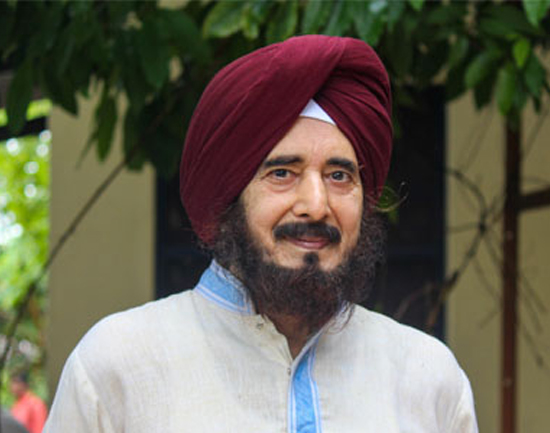
Dr. R. S. Bhogal is Joint Dir. Research at Kaivalyadhama, Lonavala, with more than thirty years of research and teaching experience, particularly pertaining to Meditation. He holds the first ever PhD in Psychology that discovers fundamental psycho-physiological bases of Shiva Samhita Meditation. Formerly, Principal of Yoga College of Kaivalyadhama (Lonavala), he is Editor-in-Chief of Yoga Mimamsa (a biennial scientific Journal) of Kaivalyadhama, and is author of seven books, including
i. Psycho-physiology of Traditional Yoga (in Korean)
ii. Yoga and Modern Psychology (in English and German)
iii. Yoga and Mental Health and Beyond (in Hindi, Gujarati, English, Bulgarian, Brazilian Portuguese, Chinese, German, Korean & Taiwanese)
iv. Yoga-Psychology & Beyond (English)
Dr. R. S. Bhogal
Dr. Bhogal is credited with a large number of scientific papers and is a recipient of many National & International awards and accolades. Recently, he has been awarded with prestigious Yoga Ratna award (2022). Widely travelled for spreading the message of classical meditation in many cities across Asia, America and Europe, Dr. Bhogal is ever ardently enthusiastic in discovering simpler methods of meditation for the modern life & living.
Registration
Regarding Registration and Booking –
For registration, the participants need to book a room first then the booking reference code to be shared at onsiteworkshops@kdham.com to reserve their spot for the workshop. The workshop fee to be paid on arrival.
Note: The fresh dates will be announced soon.
Please visit the link here for Room Tariffs
Query for this workshop? Please email us – onsiteworkshops@kdham.com
Cancellation and Refund Policy
Accommodation and meals
- Cancellation application before 7 days – refund of 75% of the amount paid.
- Cancellation application less than 7 days – no refund.
- Please email cancellation requests to booking@kdham.com. Verbal cancellation requests are not accepted.